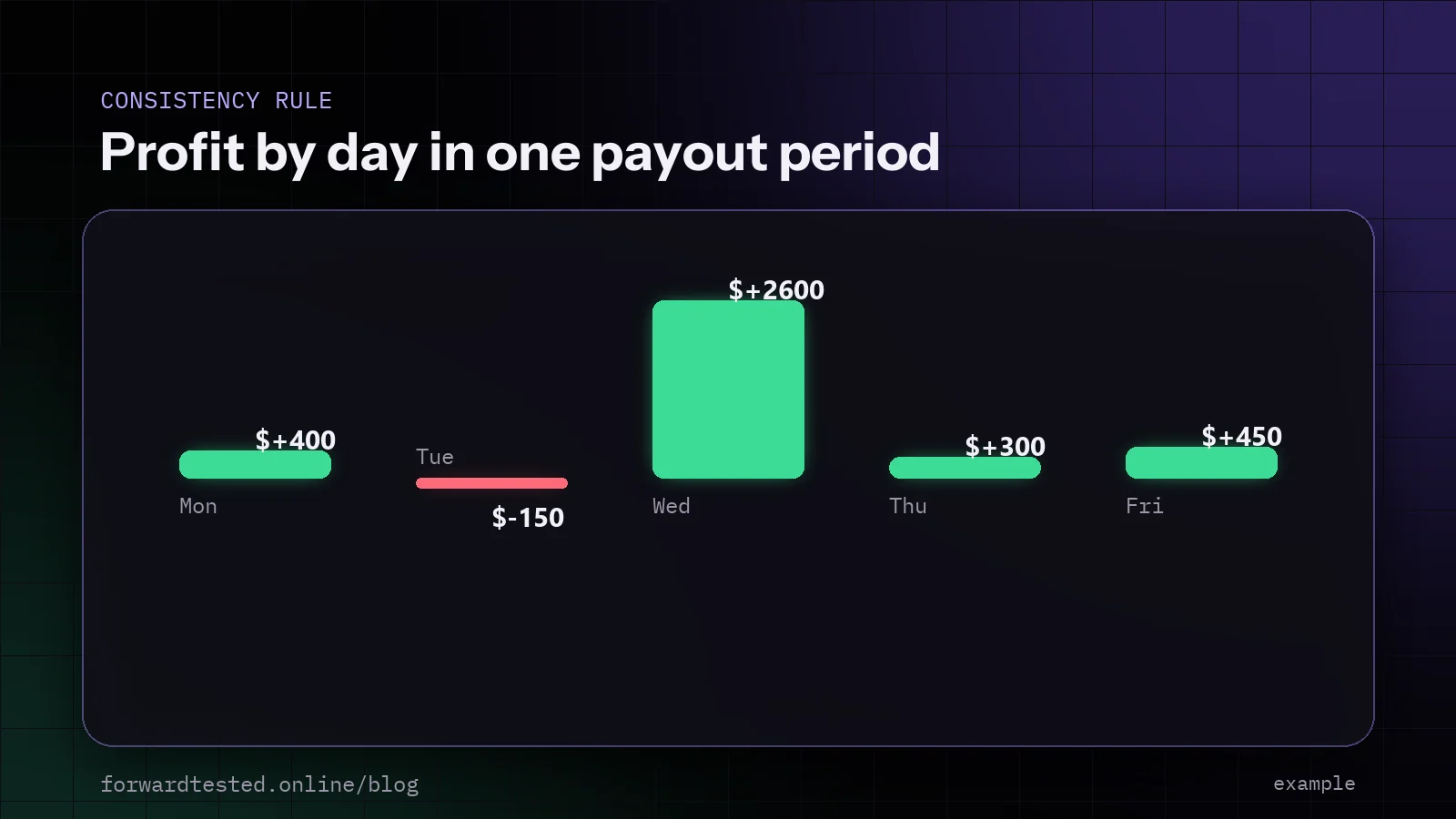
A worked example
Your payout period: Mon +$400, Tue −$150, Wed +$2,600, Thu +$300, Fri +$450. Total profit is $3,600. Best day is Wednesday at $2,600, which is 72% of the total. Under a 30% rule you'd need total profit of at least $2,600 ÷ 0.30 = $8,667 before that day counts as consistent, so you'd keep trading.
Why firms use it
Firms want funded traders whose results come from a repeatable process, not one lucky news trade or one oversized position. The rule pushes you toward steady sizing.
Where it applies
Consistency rules are common on funded accounts and some challenge products, and less common on standard 2-step evaluations. The percentage, whether losses count and whether it blocks a pass or only a payout all differ. Always read the specific programme's rules.
Different versions of the rule
| Version | How it's checked | Notes |
|---|---|---|
| Best day share | Best day ÷ total profit ≤ X% | Most common |
| Lot size consistency | Trade sizes must stay within a range of your average | Targets sudden oversized trades |
| Daily profit cap | No single day may exceed a set profit | Often on funded accounts |
Some firms combine these. Wording differs a lot, so read the programme's rules carefully.
How much total profit you need
Rearranged, the best-day rule tells you the minimum total profit for a given best day: total needed = best day ÷ allowed share.
| Best day | Needed at 20% | Needed at 30% | Needed at 40% |
|---|---|---|---|
| $1,000 | $5,000 | $3,333 | $2,500 |
| $2,000 | $10,000 | $6,667 | $5,000 |
| $3,000 | $15,000 | $10,000 | $7,500 |
Trading habits that break it
- Doubling size after a losing day to 'get back'.
- One big news trade carrying the month.
- Letting a winner run far beyond normal targets on one day.
- Stopping trading right after one huge day.
Fixed risk per trade and a daily profit cap near your target share keep you naturally consistent.
Checking it in a backtest
Group backtest profits by day and calculate the best day's share of total profit over each payout-length window. If many windows break the rule, your strategy's returns are lumpy, and you'll often wait longer for payouts even when profitable.
How to plan for it
- Keep risk per trade fixed; avoid doubling up after wins.
- Set a daily profit cap near your target share.
- Use the pace planner to see today's target and whether your next payout passes the rule.