Why a normal backtest is not enough for a prop firm
A normal backtest answers one question: did the strategy make money? A prop firm asks different ones: did equity ever drop more than the daily loss limit, did it ever touch the maximum loss, and did it reach the profit target before either happened? A strategy can make money over a year and still break a 5% daily limit on one bad Tuesday.
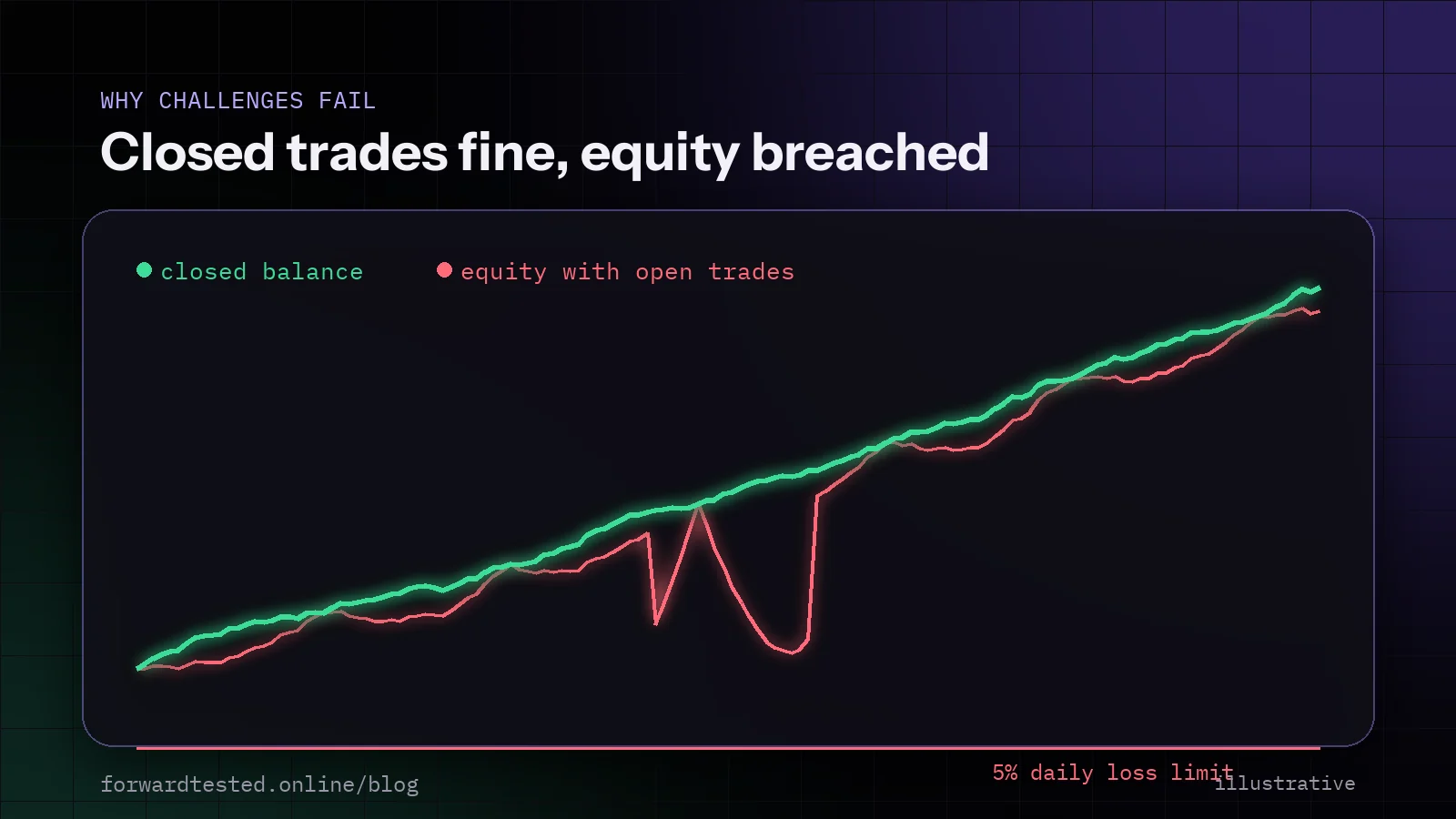
The second trap is open trades. Most firms measure losses on equity, so a trade that is down $4,000 at 10:00 and closes at breakeven at 16:00 still counts as a $4,000 loss at 10:00. Closed-trade reports hide this.
Step 1: Get a backtest you can trust
In MetaTrader 5, run the Strategy Tester with Every tick based on real ticks modelling, your real broker's symbol, your challenge size as the deposit and the same leverage. Include commission. Use at least 12 months, ideally several years, so the test covers trending, ranging and news-heavy periods.
In TradingView, the Strategy Tester runs on bars, so intrabar moves are guessed. That's fine for slow strategies but can badly understate drawdown for scalpers and grids. See TradingView backtests for prop firms.
Step 2: Replay the trades against the firm's rules
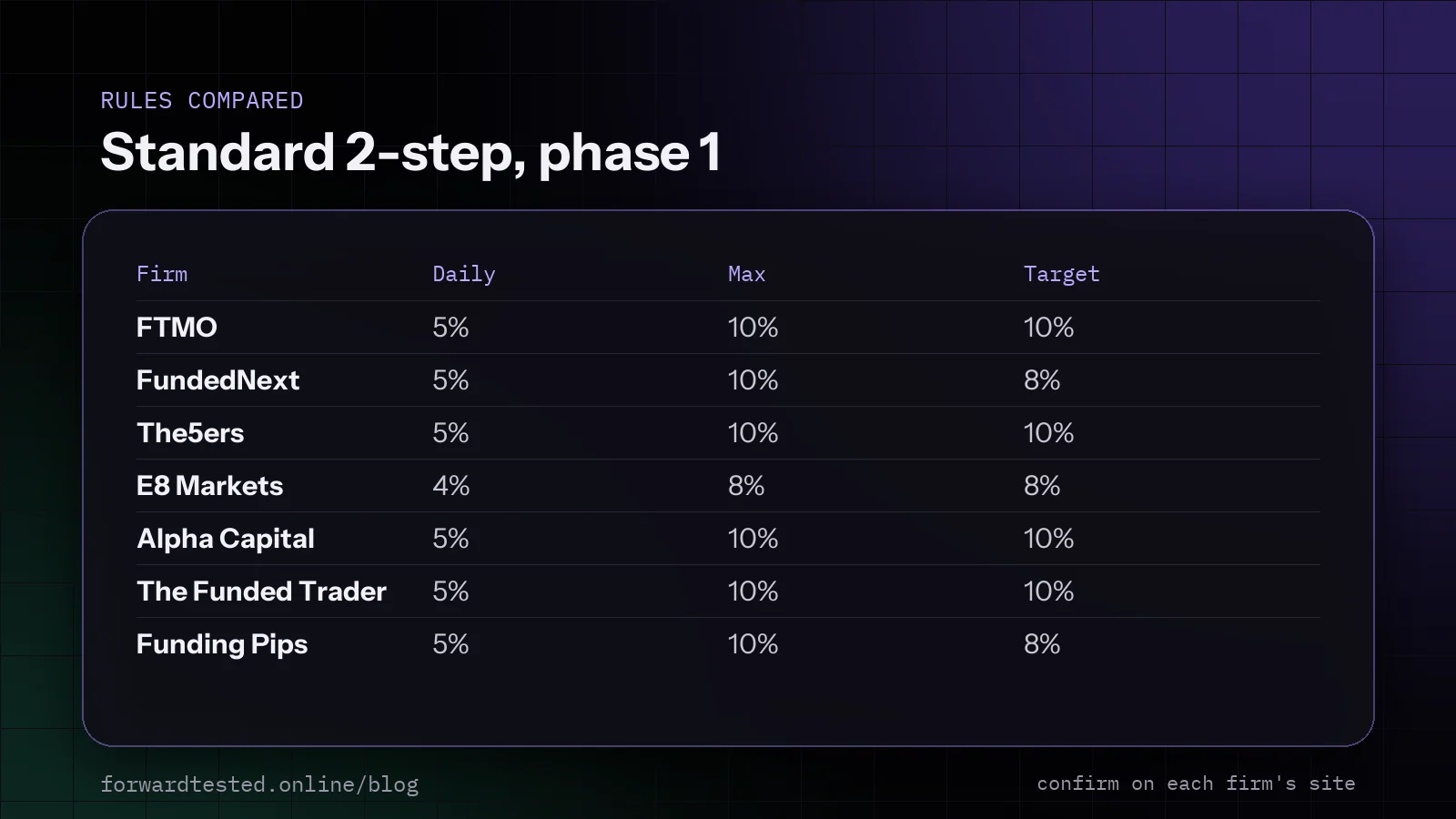
Rebuild equity minute by minute from the trade list, then apply the firm's rules as stop conditions: the moment equity breaks the daily or overall limit, that challenge has failed. Use the firm's real numbers:
| Firm (2-step, phase 1) | Daily loss | Max loss | Target | Drawdown |
|---|---|---|---|---|
| FTMO | 5% | 10% | 10% | static |
| FundedNext | 5% | 10% | 8% | static |
| The5ers | 5% | 10% | 10% | static |
| E8 Markets | 4% | 8% | 8% | static |
| Funding Pips | 5% | 10% | 8% | static |
Approximate standard rules from our open rules table. Firms change them: confirm on the firm's site.
Step 3: Start a challenge on every day of the test
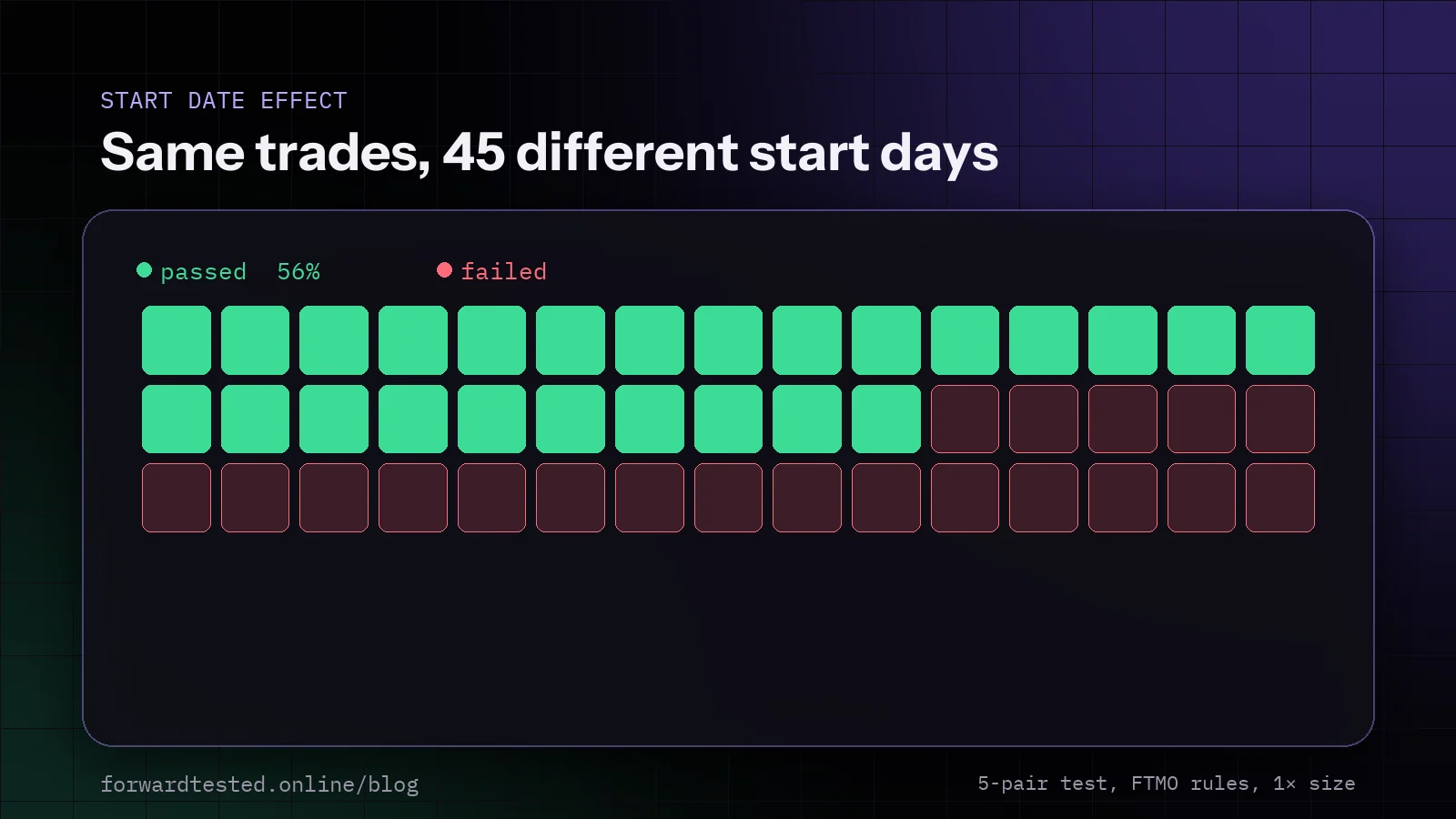
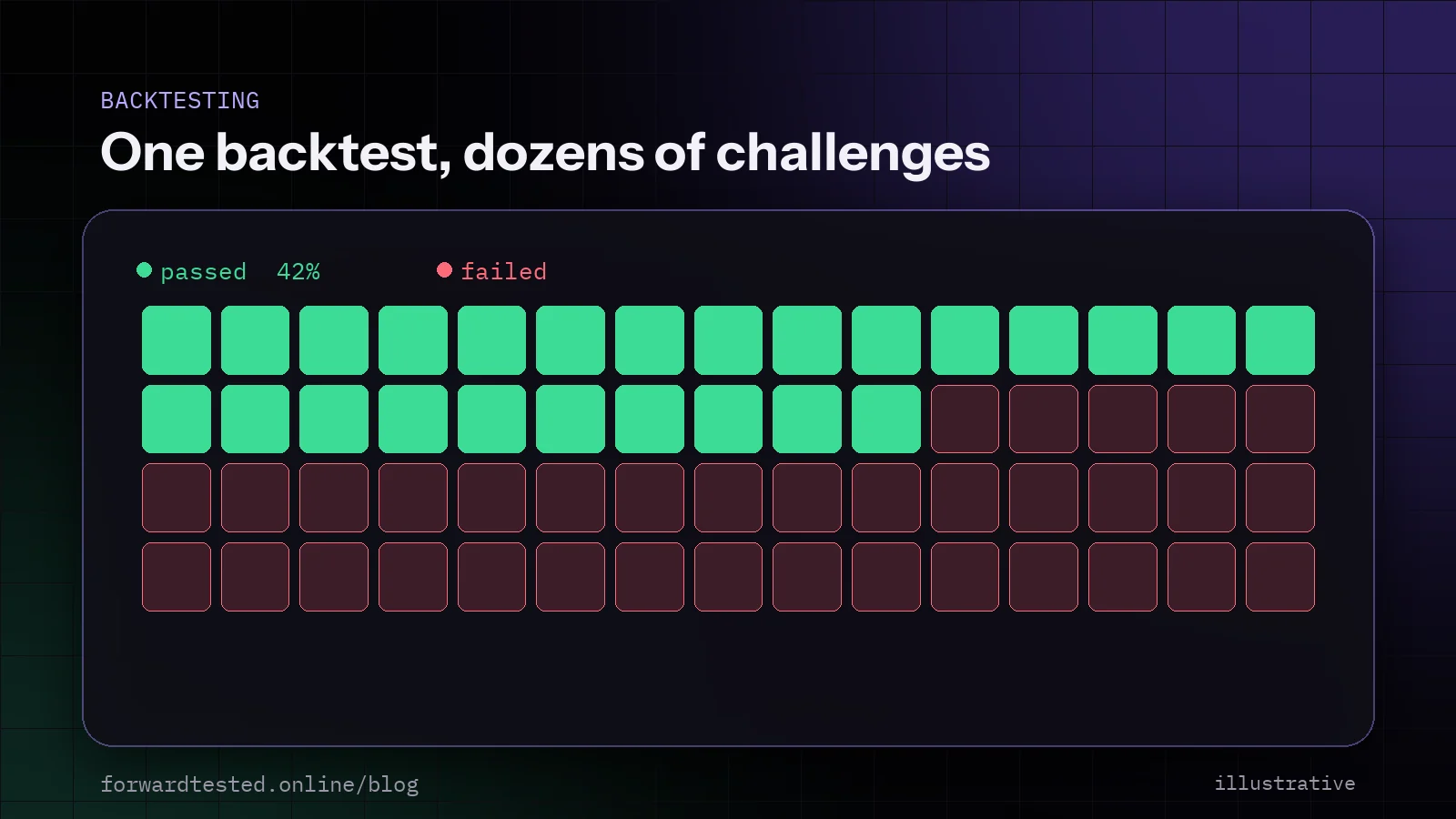
A single backtest is one path. Your challenge could start on any day, and the start date changes everything: start just before the worst week and you fail; start after it and you pass. So run the challenge from every trading day in the test and count how many pass. 30% passing and 80% passing are very different strategies, even with the same total profit.
Our data
An MT5 gold EA we replayed had 67 trades and looked profitable. Across 630 challenge starts on a $100,000 FTMO-style account it passed only 3 times at its normal size and 16 times at double size. At triple size, the daily and overall loss limits broke 25 times.
Step 4: Find the lot size that fits the rules
Pass rates move with position size. Too small and you rarely hit the target in time; too big and one bad day ends the account. Re-run the replay at 0.25×, 0.5×, 1×, 2× and 4× your lots and look for the size with the best pass rate, not the biggest profit. Then cross-check single trades with a lot size calculation.
Step 5: Forward test before you pay
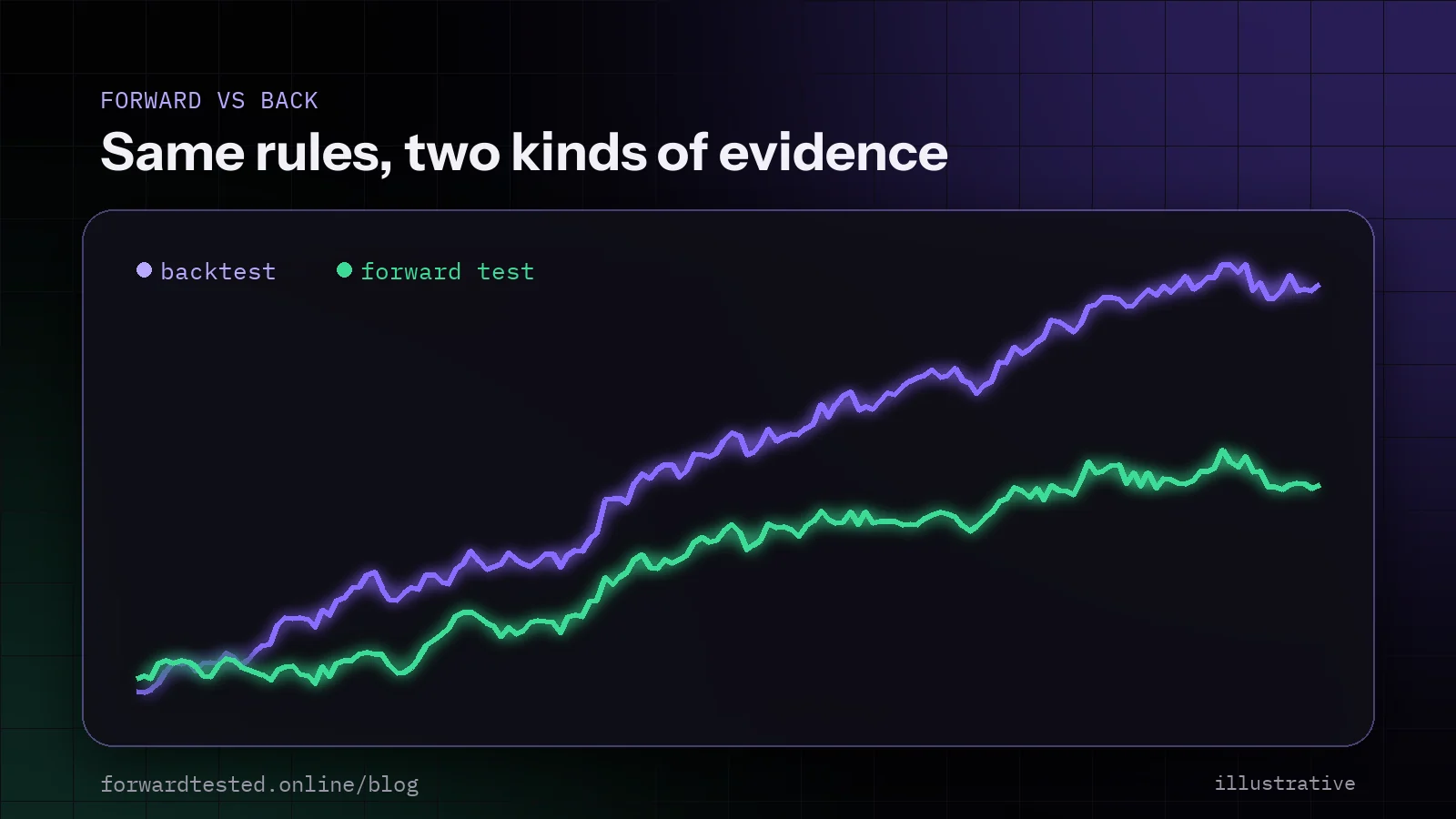
A backtest proves the idea worked on the past. A forward test on a demo account at the same broker proves it still works on prices nobody has seen, with real spreads and real fills. Run it for at least 4 weeks or 30–50 trades, then compare it with the backtest using a drift check.
Which metrics matter, and which don't
Strategy reports are full of numbers. For a prop firm, a few matter far more than the rest:
| Metric | What you want | Why |
|---|---|---|
| Worst daily equity loss | Must stay well inside the daily limit | Decides most failures |
| Max equity drawdown | Must stay well inside the max loss | Includes open trades |
| Days to reach the target | Shorter than any time limit, longer than minimum days | Too slow fails too |
| Pass rate across start dates | The headline number | Combines all of the above |
| Total net profit | Nice to know | Says little about passing |
| Win rate | Nice to know | Can hide huge open losses |
A strategy that makes 30% a year with a 4% worst day is usually a better challenge strategy than one that makes 80% with a 9% worst day, even though the second looks better in a report.
Building a backtest you can rerun
Save the exact settings, the data period, the symbol and the broker in one note next to the report. When a firm changes its rules or you try a new firm, you want to replay the same trades, not run a new backtest that's slightly different. Keep three files: the full backtest, the out-of-sample period on its own, and the forward test. Replay all three against the firm. If the out-of-sample and forward test pass rates are close to the full backtest's, your result is probably real.
A worked example from start to finish
Say you trade a London breakout on EURUSD. Five years of real-tick backtest at 1% risk per trade show 640 trades, a 1.35 profit factor and a 12% max equity drawdown. Promising, but 12% is past a 10% max loss. You replay the trades against FTMO-style rules from every start date: at 1% risk, 31% of starts pass, and most failures are the max loss in the 2022 drawdown. At 0.5% risk, 54% pass and failures shift to 'ran out of time'. At 0.75%, 58% pass. You forward test at 0.75% for five weeks: 34 trades, inside the backtest's normal range. Only now do you buy the challenge.
None of those numbers are guaranteed, but each step removed a way to fail before it cost money.
Mistakes that make a backtest lie
- Look-ahead bias: rules that use information from later in the candle (for example, entering at the low of a bar you only know after it closes).
- Survivorship: testing only on symbols or periods you picked because they look good now.
- Fixed spread on a variable market: using 0.1 pips on a pair that averages 0.8.
- Wrong account size: testing $10,000 when the challenge is $100,000 changes lot rounding and minimum lot effects.
- Ignoring swaps: strategies that hold overnight pay or earn swaps, which add up over months.
Checklist before you buy a challenge
- Real-tick backtest, costs included, 12+ months.
- Replay against the firm's daily and max loss on open equity.
- Pass rate across every start date at several lot sizes.
- Out-of-sample period the strategy was never tuned on.
- 4+ weeks of forward testing that matches the backtest.
- EA, news and weekend-holding rules allowed by the firm.